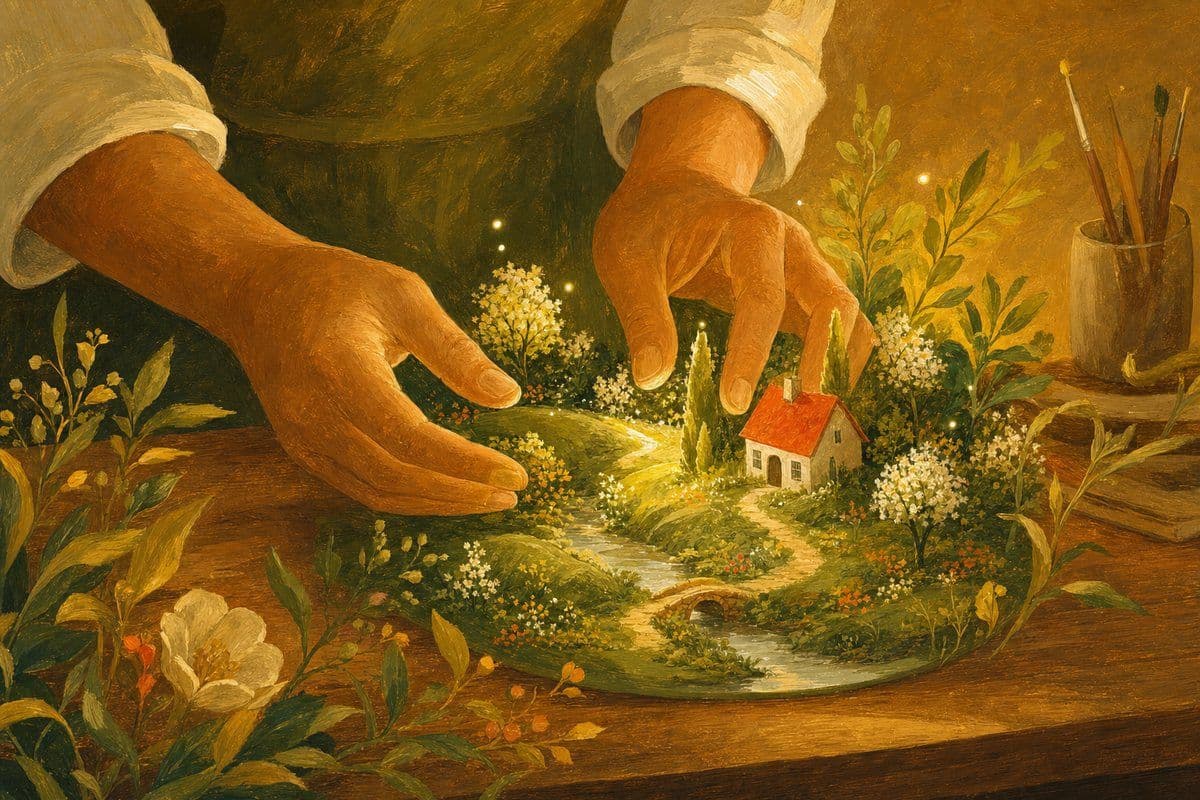
Here is a technique that lets you better meet the needs hidden behind emotional and physical pain. You can use it, for example, to:
- relieve physical pain (e.g. headache) or emotional pain (e.g. sadness);
- make better peace with someone important in your life;
- release recurring blocks (e.g. difficulty speaking your truth).
The technique is quite simple. It’s a bit like the Scanner. As you learned in the basic course, the unconscious (“young me”) symbolizes emotions and pain. So, for example, once in hypnotic trance, the guided person might symbolize anger as “a burning rock”, “a knife in the heart”, or any other symbol.
The idea behind the “life creator” technique is to transform that symbol so it takes on a living form (human, animal, plant…).
Why?
In the Scanner technique, the idea is to remove the symbol and replace it with something more beautiful and pleasant.
This often works very well, but not always. Sometimes the symbols come back right away or reappear in future sessions.
That’s a sign you haven’t reached the root of the problem.
By transforming the symbol so it takes on a living form, you can go deeper to understand the needs expressed by the pain, and above all learn to better respond to them.
How do you do it?
You simply have to ask. Our mind has infinite imagination and the ability to respond to our requests.
Here is an example of a conversation during a hypnotic session:
Guide: “How does that feel inside?”
Guided: “I feel anger in my stomach.”
Guide: “What could that be like in your stomach? A volcano? A ball of metal? A cloud? Or maybe something else?”
Guided: “Oh! It’s like a ball of metal, very hot, red, with spikes.”
Guide: “Ok. Ask that ball of metal to transform and take on a living shape, maybe like a human or an animal, for example.”
Guided: “It’s an enraged dragon caught in chains, unable to move.”
Guide: “What could you do to help this dragon? Could you free it? Move it somewhere closer to its family? What does it need? Maybe to fly or to eat…”
(The idea is to understand the dragon’s needs and encourage the guided person to meet them until the dragon is perfectly happy.)
Guided: “I need to start by freeing it from its chains. Then guide it back to its mate and its children…”
Guide: “Perfect. So now, how does it feel in your stomach? Is there still a ball there, or is it lighter and more pleasant?”
You can imagine each living being as an aspect of the guided person.
By meeting the needs of the living beings they encounter within themselves, the guided person learns to meet their own needs.
During the session, take note of the solutions the guided person finds to make the living beings they meet happy; you can then offer them metaphorical prescriptions consistent with those solutions.
For example, if the guided person met a bored monkey and the solution was to play with its friends, you could suggest they set up a game night with a friend in real life.
It is natural for humans to feel empathy for other humans — and also for animals.
That’s why it’s best to transform symbols into humans or animals rather than into plants.
Animals, close enough to be understood but distant enough to foster detachment, are often ideal.
Bonus round
If you feel it’s necessary, you can also look for the emotion behind the emotion:
- Ask to transform the symbol so that it takes on a living form. Let’s say it takes the form of a chained elephant.
- Ask the chain that binds it to also take on a living form. Let’s say it becomes a snake.
- Give the snake what it needs to be happy (e.g. food, a pleasant environment, cuddles, etc.).
- Once the snake is happy, go back to the elephant: most of the time, it will be doing much better. Give it too what it needs to be perfectly happy.
- Note the solutions found and suggest corresponding metaphorical acts (e.g. if the snake needed cuddles, ask how the guided person could get more of that in their life).
Important
Sometimes the guided person doesn’t like the living being they encounter at all: they may find it disgusting, scary, mean, ugly…
Your role as guide is to bring them to like it enough to want to give it what it needs to be happy.
The appearance of the living being is directly linked to the guided person’s attitude: as soon as they improve their attitude, the being becomes more beautiful and pleasant.
These living beings are metaphors for aspects of the guided person.
By making peace with them, the guided person makes peace with parts of themself — and that does them a world of good.
Notes
You can explore how the dragon came to be chained and fix the problem at the root.
For example, the guided person might say that the dragon was chained by his wife, angry because he yelled at their daughter…
You can go back through the story until everyone is happy: the daughter, the wife, and the dragon.
The idea is to understand the dynamic of the story and do what’s needed for it to become harmonious in every respect.
More articles and videos

The role of the guide in holistic hypnosis (metaphor)
The guide in holistic hypnosis plays a role similar to that of a mountain guide.
Read ›
I killed to protect him
Discover how symbolic language can durably soothe your emotions and restore inner balance.
Read ›
What are the origins and inspirations behind the Méthode Dolfino?
Discover the Méthode Dolfino®: a fusion of classical hypnosis, Ericksonian hypnosis, consciousness expansion, and NLP, enriched with games and tools grounded in neuroscience for playful, effective personal development.
Read ›